
Quick contact info

Gabbro Crusher is a truly professional industrial company built to last. We deliver reliable gabbro crushing solutions for construction, infrastructure, and large-scale engineering projects.

icon_widget_image Monday-Saturday: 10 am to 6pm icon_widget_image H.O: Ground Floor, 50D, Muktaram Babu Street, Kolkata - 700 007 icon_widget_image +91 7004 247 461 +91 7644 940 911 icon_widget_image info@gabbrocrusher.com vikash@gabbrocrusher.com
Sand Washing Machine Manufacturer in India - G wash - hydro cyclone sand washing - gabbro crusher
G Wash Series Hydro Cyclone Sand Washing Machine Manufacturer India - Gabbro Crusher
Sand Washing & Classification

G Wash Series
Hydro Cyclone
Sand Washer

High Efficiency Sand Washing & Dewatering System

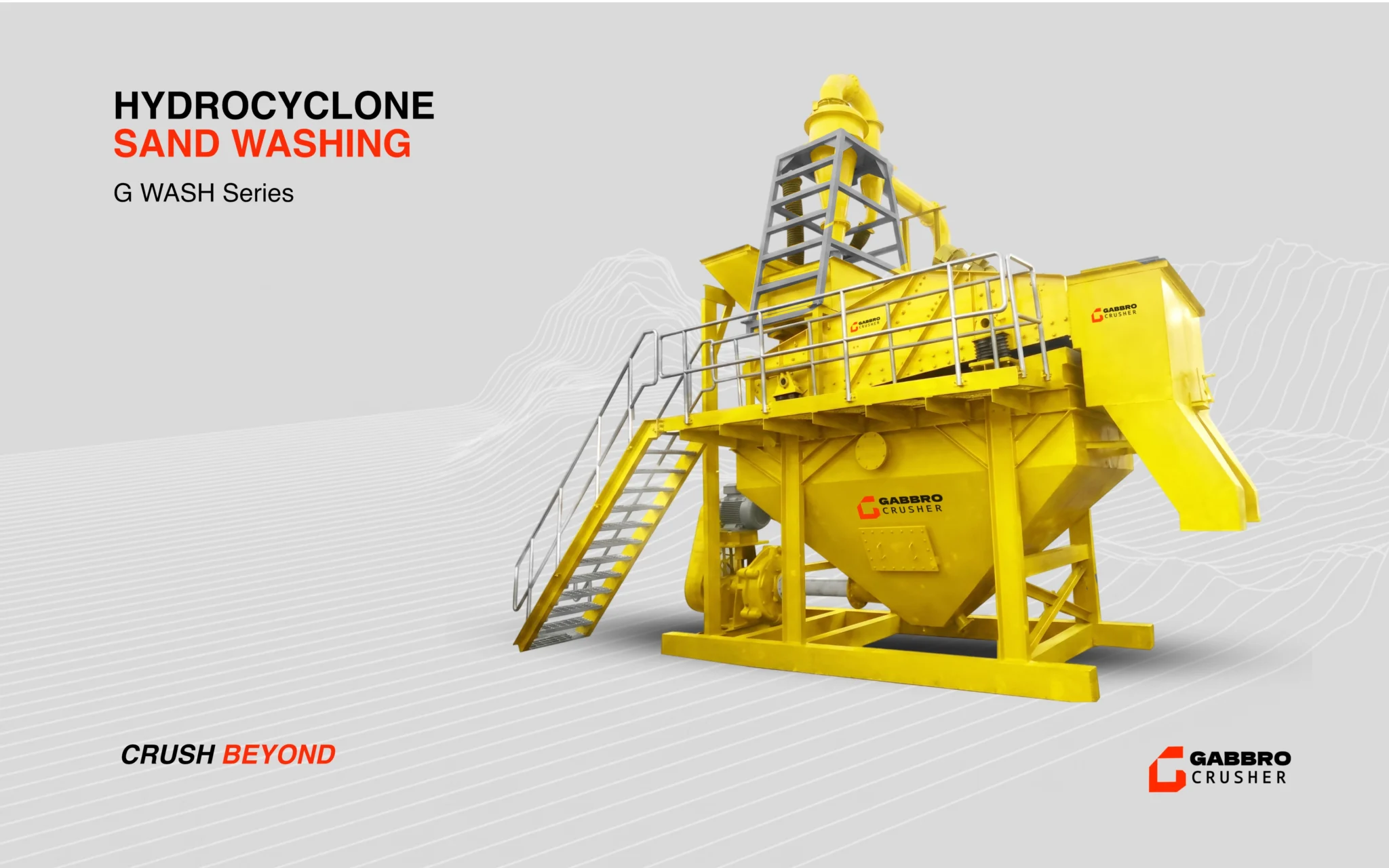
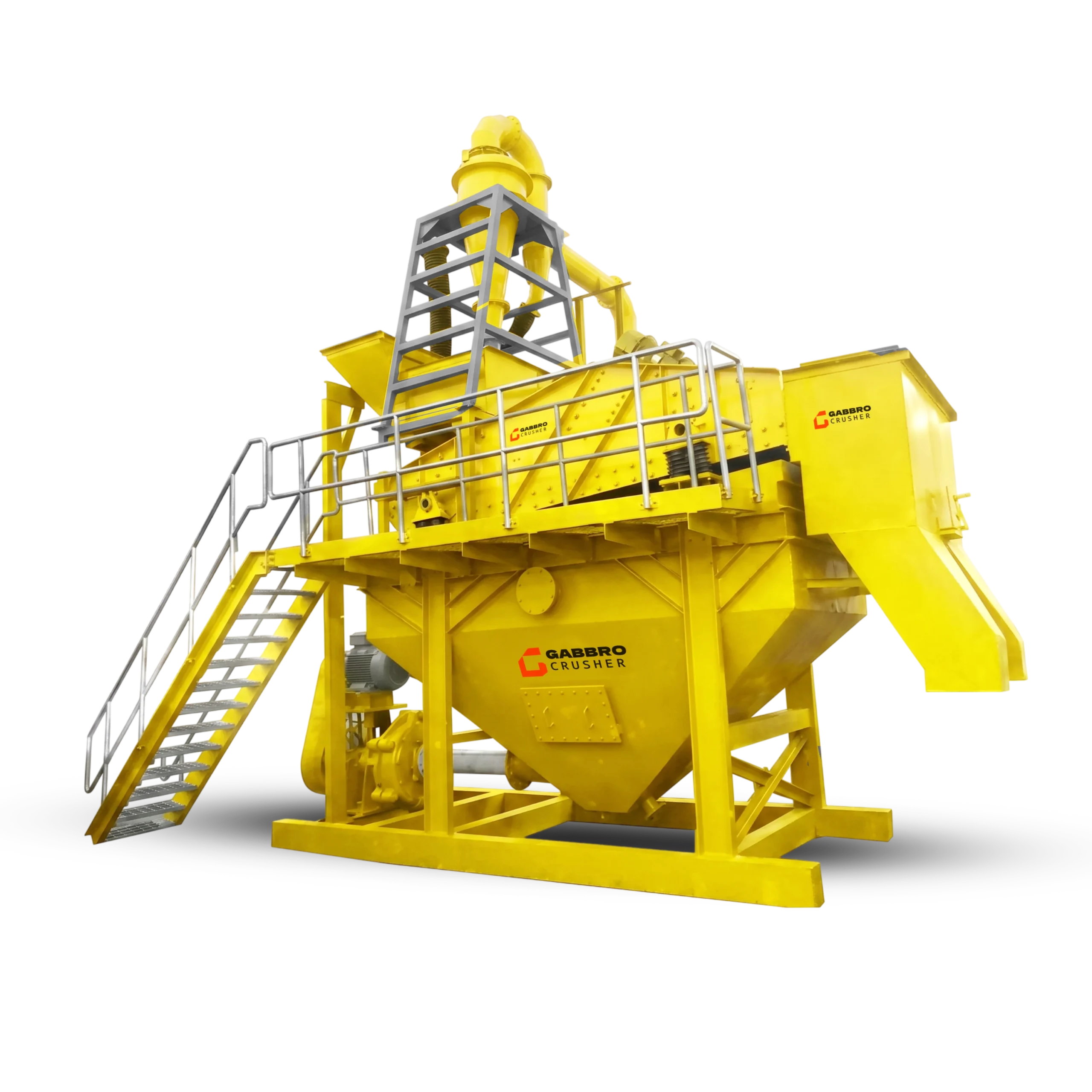
The G Wash Series Hydro Cyclone Sand Washing Machine by Gabbro Crusher is engineered for high-efficiency sand classification, washing, and dewatering in a single compact system. Using centrifugal force through a precision-designed cyclone chamber, it effectively separates fine particles, removes clay, silt, and impurities from manufactured sand and river sand β€” delivering a clean, well-graded final product that meets the strictest construction and concrete production standards.

Unlike conventional bucket wheel washers, the G Wash Hydro Cyclone system operates with significantly lower water consumption while achieving superior washing efficiency. Its closed-loop water recycling design minimises water wastage β€” making it the ideal solution for quarry operators and aggregate producers in water-scarce regions across India. The integrated dewatering screen ensures the washed sand is discharged at optimal moisture levels, ready for immediate use or stockpiling.

As a trusted sand washing machine manufacturer in India, Gabbro Crusher builds the G Wash Series for continuous high-volume operation with minimal maintenance β€” delivering consistent product quality and low cost per tonne across all sand washing applications.

Key Advantages of Our Sand Washing Machine in India

  • High-efficiency cyclone separation removes clay and silt effectively
  • Low water consumption with closed-loop recycling system
  • Integrated dewatering screen for optimal moisture output
  • Consistent well-graded clean sand meeting IS standards
  • Compact design β€” easy integration into existing plants
  • Low maintenance with minimal moving parts
  • Suitable for manufactured sand and natural river sand
  • Reduces reject fines and improves overall sand recovery

Where Is G Wash Sand Washer Used?

Manufactured Sand Plants River Sand Processing Concrete Production Road Construction Aggregate Washing Plants Mining Operations
Product Anatomy

How G Wash Series Works

G Wash Hydro Cyclone Sand Washer Parts Diagram
1
2
3
4
5
1
Feed Inlet & Slurry Pump
Raw sand slurry is fed under pressure through the tangential feed inlet at the top of the cyclone. The high-velocity tangential entry creates a powerful centrifugal vortex inside the cyclone chamber β€” the driving force behind all separation and classification.
2
Cyclone Chamber
The precision-engineered cyclone chamber uses centrifugal force to separate sand particles by size and density. Heavier, coarser sand particles are thrown outward and downward toward the underflow, while fine particles, clay, and silt are carried upward with the water overflow β€” achieving exceptional classification accuracy.
3
Overflow & Water Recycling
The overflow from the cyclone carries ultrafine particles, clay, and silt-laden water to a settling tank or thickener for water recovery and recycling. The G Wash closed-loop water system significantly reduces fresh water consumption β€” making it environmentally efficient and ideal for water-scarce quarry sites.
4
Dewatering Screen
The washed sand underflow from the cyclone is discharged directly onto the integrated linear motion dewatering screen. The vibrating screen rapidly dewaters the sand to optimal moisture content β€” typically 12–15% β€” making it immediately suitable for stockpiling, bagging, or use in concrete and asphalt production without additional drying.
5
Clean Sand Discharge
The final clean, well-graded, dewatered sand is discharged from the screen outlet ready for use. The G Wash Series consistently delivers sand that meets IS 383 grading standards β€” free from harmful clay and silt content β€” making it the preferred washing system for manufactured sand (M-Sand) plants and natural sand processing operations across India.
Technical Data

GWash Hydro Cyclone
Sand Washer Specifications

All GWash Series Sand Washers are manufactured to order. Specifications are subject to change without notice. Contact Gabbro Crusher for custom configurations and capacity requirements.

Specification GWash 75Model GWash 100Model GWash 150Model GWash 200Model
Capacity 60 – 80 TPH 90 – 110 TPH 120 – 160 TPH 160 – 200 TPH
Dewatering Size
L Γ— W (m)
2.1 Γ— 1.5 2.5 Γ— 1.5 2.8 Γ— 1.8 4 Γ— 2.3
Dewatering Power 15 kW 20 kW 30 kW 30 kW
Slurry Pump Power 15 kW 20 kW 30 kW 30 kW
Slurry Pump Size β€” Suction 3 inch 4 inch 6 inch 6 inch
Slurry Pump Size β€” Delivery 2 inch 3 inch 4 inch 4 inch
Cyclone Feed Pipe Size
L Γ— W (m)
2 Γ— 2.2 2 Γ— 2.2 2 Γ— 3.2 2 Γ— 5
Machine Size
L Γ— W Γ— H (m)
4.1 Γ— 5 Γ— 5.1 5 Γ— 5.1 Γ— 5.5 6 Γ— 5.5 Γ— 5.5 8 Γ— 6 Γ— 5.8

SITE PHOTO GALLERY

SAND WASHING MACHINE MANUFACTURER IN INDIA - GABBRO CRUSHER

gabbro crusher sand making plant - vsi crusher manufacturer in india- Nepal- Bhutan - sand making machine - sand washing plant
Expert Answers

Hydro Cyclone Sand
Washer FAQs

Performance Metric G Wash Hydro Cyclone Traditional Screw Washer
Fines Recovery (%) Up to 95% 60 – 75%
Output Moisture (%) 10 – 15% 18 – 25%
Water Consumption Low β€” closed loop recycling High β€” open circuit
D50 Cut Point Control Precise β€” adjustable Limited control
Footprint Compact Large
Maintenance Low β€” minimal moving parts High β€” spiral/screw wear
πŸŒͺ️ Separation Physics & Efficiency
Pressure drop across the hydrocyclone directly controls slurry velocity and therefore separation efficiency. Higher inlet pressure increases centrifugal force, producing a finer cut point and capturing smaller particles in the underflow. However, excessive pressure accelerates wear on the polyurethane liners β€” particularly at the apex and vortex finder. For the G Wash Series, optimal operating pressure is typically 0.5 to 1.0 Bar for standard silica sand applications. Always balance pressure against liner wear rate and your required D50 cut point for the most cost-effective operation.
The D50 cut point is the particle size at which exactly 50% of the material reports to the underflow (clean washed sand) and 50% reports to the overflow (waste fines and silt). It is the gold standard metric for measuring the sharpness of hydrocyclone separation. For the G Wash Series operating on silica sand with a specific gravity of 2.6–2.7, the D50 cut point is typically adjustable between 45 and 150 microns depending on vortex finder diameter, apex size, and inlet pressure settings.
Roping β€” where the underflow discharges as a thick solid rope instead of a hollow fan spray β€” means the apex is overloaded with solids, causing sand loss into the overflow. Common causes: feed slurry above 30% solids by weight, apex diameter too small, excessive feed pressure, or a failed scalping screen allowing oversized particles in. The correct underflow should always be a wide hollow cone spray. If roping occurs, reduce feed density, increase the apex size, or reduce pump speed immediately to prevent sand loss and efficiency drop.
πŸ’§ Moisture & Fines Management
A well-tuned G Wash Series system consistently delivers washed sand at 10% to 15% moisture content by weight β€” significantly drier than traditional bucket wheel washers which typically discharge at 18–25% moisture. At 10–15% moisture, sand is immediately suitable for conveying, stockpiling, bagging, or use in concrete and asphalt production without additional drying or waiting time β€” directly improving plant productivity and reducing downstream handling costs.
Yes β€” with correct configuration, the G Wash Series can capture particles as fine as 20–45 microns in the underflow. Recovering material below 75 microns requires a smaller vortex finder diameter, a smaller apex, and reduced inlet pressure. For manufactured sand (M-Sand) applications where fines below 75 microns must be controlled within IS 383 limits, the G Wash system can be precisely tuned to either capture or reject this fraction as required β€” giving plant operators full control over their final product grading.
The ideal feed slurry density is 10% to 30% solids by weight. Below 10%, centrifugal forces are insufficient for sharp separation, resulting in excessive sand loss to overflow. Above 30%, the slurry becomes too viscous and roping becomes likely. For the G Wash Series processing silica sand with a specific gravity of 2.6–2.7, a feed density of 15–25% solids by weight consistently delivers the best balance of separation sharpness, throughput, and liner wear life.
πŸ”§ Wear, Parts & Durability
High-shore polyurethane liners (85–90 Shore A) typically last 3 to 5 times longer than natural rubber liners in abrasive silica sand applications. In a standard quarry processing granite-derived manufactured sand, polyurethane liners commonly achieve 4,000–8,000 operating hours before replacement, compared to 1,500–2,500 hours for rubber. The performance advantage is most significant at the apex and vortex finder β€” the two highest-wear zones. G Wash Series cyclones use polyurethane liners as standard to minimise maintenance frequency and long-term cost of ownership.
Premature vortex finder wear is almost always caused by oversized particles entering the cyclone β€” typically due to a failed or bypassed primary scalping screen. Other causes include excessively high inlet pressure, incorrect liner material for the abrasivity of sand being processed, or hard angular particles like crushed granite at the top of the size range. Always ensure a properly maintained scalping screen is installed upstream of the G Wash system and verify inlet pressure remains within the recommended operating range to maximise vortex finder life.
For cleaner feed with low silt content, reduce pump speed via the Variable Frequency Drive (VFD) to lower pressure and coarsen the D50 cut point β€” maximising sand recovery. For dirtier feed with high clay and silt, increase pump speed to sharpen the cut point, driving more fines to overflow. Alternatively, use adjustable apex valves to control underflow density without changing pump speed. For extreme feed quality variation β€” common in river sand operations with seasonal clay changes β€” a combination of VFD pump control and interchangeable vortex finder inserts gives the widest operational flexibility on the G Wash Series.
About Our Sand Washing Machines

Your Trusted Sand Washing Machine
Manufacturer in India

As a leading sand washing machine manufacturer in India, Gabbro Crusher has been designing and supplying the G Wash Series Hydro Cyclone Sand Washing Machine since 2011 β€” serving manufactured sand plant operators, river sand processors, and aggregate producers across West Bengal, Northeast India, Nepal, and Bhutan. Every G Wash Series machine we manufacture is built for continuous high-volume operation with minimal maintenance and the lowest cost per tonne of washed sand produced.

Our sand washing machine manufacturing facility in India produces the G Wash Series in four models β€” GWash 75, GWash 100, GWash 150, and GWash 200 β€” covering capacities from 60 TPH to 200 TPH to suit every plant size and production requirement. Whether you need a sand washing machine for an M-Sand plant in Northeast India, a hydro cyclone system for river sand processing in Nepal, or a complete sand washing and dewatering solution for an aggregate plant in Bhutan β€” Gabbro Crusher delivers with full installation support and after-sales service.

Looking for the best sand washing machine price in India? Contact Gabbro Crusher today for a free consultation and competitive pricing on the complete G Wash Series range. Our engineering team will help you select the right model for your feed material, required capacity, and site conditions β€” ensuring maximum dewatering efficiency and consistent washed sand quality meeting IS 383 standards from day one.